Do You Become an Owner of a Company When You Buy a Stock? Teaching Kids the Basics of Stocks and Businesses
Category: Financial Education for Kids | Reading time: ~13 minutes
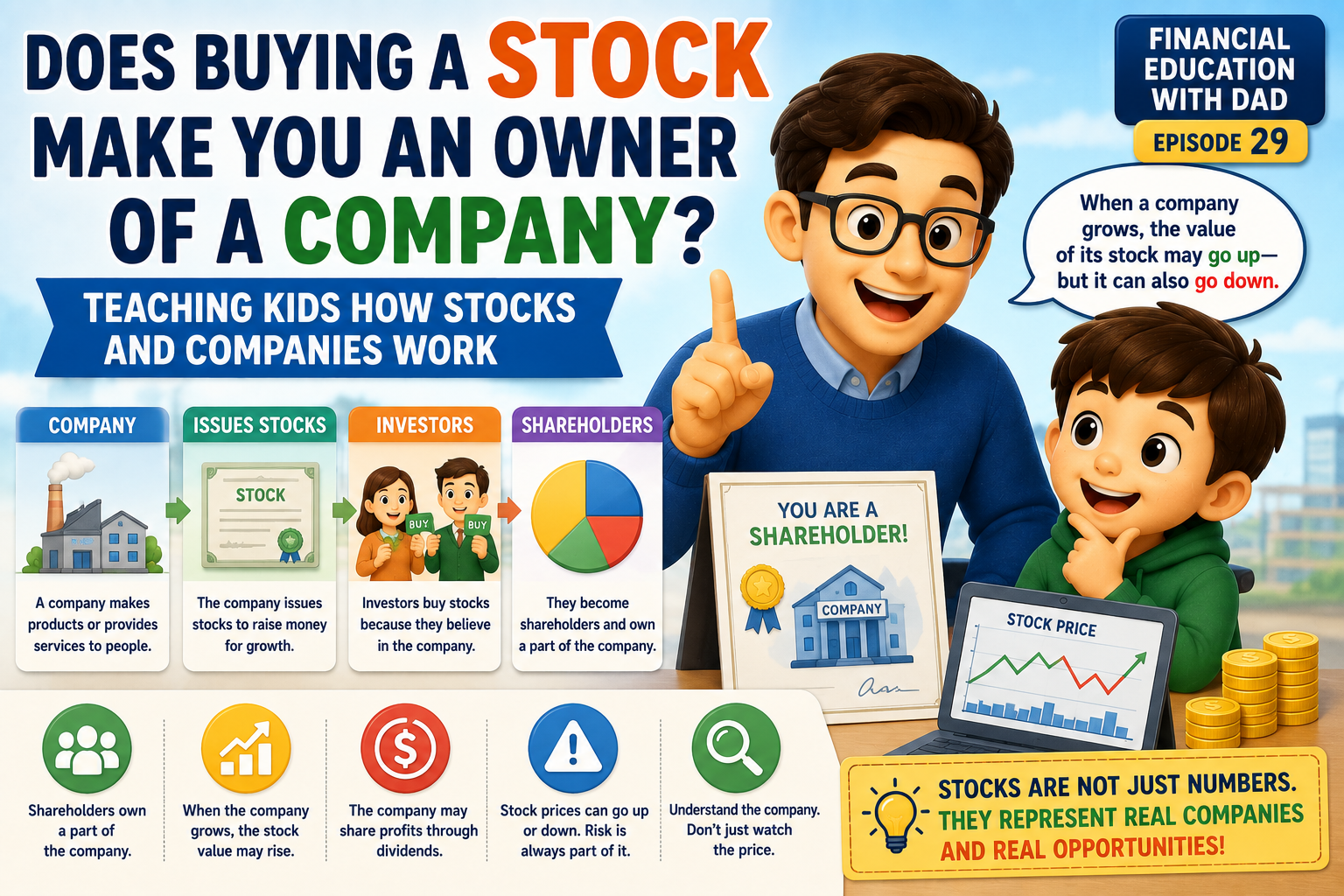
Introduction: More Than Just a Rising Number
Hello, I'm the writer behind The Financial Education Dad.
In Part 28, we learned what investing is and how it differs from saving — saving focuses on protecting and steadily growing money for future needs, while investing means accepting the possibility of loss in exchange for a chance to participate in future growth. We also learned that good investing starts not with "how much can I make?" but with "how much could I lose?"
Now it's time to introduce the investment topic children hear most often: stocks. Every day, the news talks about prices rising and falling, and if parents invest, kids naturally overhear things like "my stocks went up today" or "the stock market dropped." But ask a child what a stock actually is, and the first question is usually simple: "what is a stock?" Right behind it comes another: "do I really become part owner of a company if I buy one?"
In this article, let's explore why companies issue stocks, what shareholders are, what it really means to own shares, and how children can begin understanding businesses instead of simply watching prices.
1. What Is a Company?
Before children can understand stocks, they need to understand businesses. Imagine a small bakery starting with one oven and a few tables. As customers discover the bread, the owner dreams bigger — a larger oven, another store, new recipes, more employees. All of these dreams require money.
Companies face the same challenge: they need money to build factories, develop products, hire people, expand, and create new technology. There are a few ways to raise that money — borrow from a bank, or invite investors to become part owners. That second path is exactly where stocks come in.
2. What Is a Stock?
One of the easiest ways to explain stocks is with a pizza. Imagine a whole pizza represents a company, then cut it into many slices — each slice is a tiny piece of ownership. Stocks work the same way: a stock represents a small ownership share in a company, and the people who own those shares are called shareholders.
Tell your child: "a stock is a tiny piece of ownership in a company." Stocks aren't literal pizza slices, of course, but the analogy makes shared ownership click quickly.
3. Do You Really Become an Owner?
Yes — but not quite the way children often imagine. Owning stock makes you a shareholder, meaning you own a small part of the company. It doesn't mean you can suddenly tell everyone what to do.
Imagine the pizza divided into 100 slices — owning one slice means owning part of the pizza, not the whole thing. The same applies to stocks: "buying one stock doesn't make the whole company yours. It makes you one of many owners."
4. Why Would a Company Share Ownership?
Children often ask, reasonably: "why would a company give part of itself to other people?" Because growing a business can require enormous amounts of money. Building a new factory might cost millions — more than a company has saved. Instead of borrowing everything, it can raise funds by selling shares to investors.
Investors provide money because they believe the company may grow. The company gets funding; investors get ownership. Both sides benefit if the business succeeds.
5. Does My Money Go Directly to the Company?
This trips up plenty of adults too. When a company first sells new shares to investors, that money can go directly to the company. But once shares trade on the stock market afterward, the money usually goes to whoever is selling the stock — not directly to the company itself.
Children don't need every technical detail here — just the core distinction: "companies raising money and investors trading existing shares are two different things."
6. Why Do Stock Prices Change Every Day?
A stock might cost $50 this morning and $52 — or $48 — by afternoon. Why? Simply put: people constantly change their opinions about a company's future. Investors might believe growth is accelerating, or worry about competition, economic conditions, new products, interest rates, or shifting consumer tastes.
Stock prices move because expectations keep shifting, not because the underlying business necessarily changed overnight.
7. Does a Good Company Always Have a Rising Stock Price?
One of the most important lessons in investing: no. A wonderful company and a wonderful investment aren't always the same thing. Even an excellent company can turn into a poor investment if its stock was bought at an unrealistically high price. Likewise, a company facing temporary trouble may recover later.
Help your child hold onto this line: "a great company doesn't mean its stock goes up every day."
8. If a Company Earns More Money, Do Shareholders Get It All?
Not necessarily. Companies can use profits many ways — building new factories, developing better products, investing in research, strengthening the business. Sometimes they also share part of profits with shareholders, called a dividend.
A simple explanation: "a dividend is part of a company's profit that may be shared with shareholders." Not every company pays one, and the amount can change over time.
9. How Do People Make Money From Stocks?
Two basic ideas are enough for a child:
- The stock price rises. Buy at $10, sell later at $12, and that's a gain — though the price could just as easily fall to $8.
- Dividends. Some companies share part of their profits directly with shareholders.
The important lesson underneath both: neither method guarantees profit. Stocks are fundamentally different from a savings account.
10. What Happens If a Company Struggles?
Investment education should never tell only success stories. Companies can lose customers, competitors can win, new technology can reshape an industry, and businesses can even fail. When a company struggles, shareholders can lose money too.
This connects directly back to Part 28: investing means participating in both opportunity and risk, not just one side of that coin.
11. What Rights Do Shareholders Have?
Shareholders are more than people watching a price tick up and down. Because they own part of a company, they may have certain rights depending on the company's structure and applicable law — one common example is voting at shareholder meetings on major decisions.
Children don't need the legal detail — just the idea: "owning part of a company can give you a voice in some important decisions."
12. Use Companies Children Already Know
The best investment lesson often starts with a familiar brand. Ask: what does this company make? Who buys its products? How does it earn money? Who are its competitors? Will people still want these products in the future?
This shifts attention from the stock price toward actually understanding the business behind it.
13. Stocks Are Not a Price-Guessing Game
If children spend all their time predicting tomorrow's price, investing starts to feel like gambling. Encourage them to observe companies instead — what are they building, how are they changing, what opportunities and challenges do they face? Buying a stock means buying part of a business, not just a number flashing on a screen.
14. Is a Famous Company Automatically a Good Investment?
Children often assume: "everyone knows this company, so it must be a great stock." But popularity alone isn't enough — a beloved brand, a successful business, and an attractive investment are related, but not identical. Learning to separate admiration for a brand from genuine investment judgment is an important financial habit.
15. If the Stock Price Falls, Is the Company Suddenly Bad?
Imagine a stock falls 5% in a single day. Did the factories disappear overnight? Did every employee quit? Did customers suddenly stop buying everything? Usually not. Short-term prices move for all sorts of reasons — children should learn to separate a company's real underlying business from its constantly shifting market price.
16. Why Is Putting All Your Money Into One Company Risky?
Even great companies face unexpected problems — new competitors appear, industries shift, management makes mistakes. That's why diversification matters. Remind children of the egg basket example: "even a strong basket shouldn't hold every egg." Diversification reduces the risk of depending on just one company's fortunes.
17. Should You Check Your Stocks Every Day?
If children build a pretend portfolio, they'll likely want to check prices constantly. Encourage checking in every few weeks or months instead, asking: did it launch a new product? Are more people using it? Has the business improved? What news has it announced? This turns investing from price-watching into genuinely understanding a business.
18. Family Activity: Become a Company Detective
No real money needed. Pick a favorite company and investigate together, writing down: company name, what it sells, who its customers are, how it earns money, who its competitors are, why it might grow, and what could make it struggle.
That final question is especially valuable — investing isn't about predicting the future perfectly. It's about thinking through multiple possibilities at once.
19. Hold Your Own Family Shareholders' Meeting
Create an imaginary company together — maybe "The Family Cookie Company." Each family member owns shares, the company earns a profit, and now the family votes: buy a new oven? Create new cookies? Advertise? Share some profits with shareholders?
Children quickly discover that companies are organizations making long-term decisions — not machines that simply produce money on their own.
20. Seven Stock Lessons Every Child Should Remember
- A stock represents part of a company.
- People who own stocks are called shareholders.
- If a company grows, shareholders may benefit.
- If a company struggles, investors can lose money.
- Great companies don't guarantee rising stock prices.
- Never invest just because a brand is famous.
- Understand the business before watching the stock price.
21. What Parents Should Avoid
- Don't celebrate profits alone. Children may start seeing stocks as easy money.
- Don't treat losses as failure. They're opportunities to learn.
- Don't turn investing into a guessing game. The goal is understanding businesses, not predicting tomorrow's price.
- Don't invest just because your child loves a brand. A favorite company isn't automatically a good investment.
- Praise thoughtful reasoning more than results. Instead of "how much did you make?", try "why did you think this company was worth studying?"
Conclusion: Businesses Before Prices
Once children understand stocks, they start seeing the world differently. At the grocery store: "how does this company make money?" When a new smartphone launches: "what might this mean for the company?" At an amusement park: "where does this business earn its income?" Everyday life quietly becomes an economics classroom.
The first thing people notice about a stock is usually the price — today's number, yesterday's gain, tomorrow's prediction. But behind every stock price is a real company: people designing products, employees solving problems, customers making choices, leaders investing for the future. That's why I believe children should learn about businesses before prices.
Before asking "will this stock go up?", ask "what does this company actually do?" Before asking "how much money can I make?", ask "how does this business create value?" And before asking "should I buy it?", ask "what risks could this company face?" If children learn to ask these three questions, they'll start seeing stocks not as a money-making game, but as ownership in real businesses and participation in their future.
Today, take a walk through your neighborhood with your child and point to a familiar company, then ask one simple question: "what does this company sell, and how does it earn money?" If that conversation begins, so has a wonderful journey into business and investing.
Coming Next: Financial Education for Kids (Part 30)
What Are Mutual Funds and ETFs? Teaching Kids How to Invest in Many Companies at Once
What if investing in just one company feels too risky? Is there a way to invest in dozens — or even hundreds — of companies all at once? In Part 30, we'll explore mutual funds, ETFs, diversification, costs, and risk, and explain how children can understand the idea of putting many investments into one basket instead of relying on just one.
— The Financial Education Dad
Previous Episode: [28] What Is Investing? How to Teach Kids the Difference Between Saving and Investing
[28] What Is Investing? How to Teach Kids the Difference Between Saving and Investing
What Is Investing? How to Teach Kids the Difference Between Saving and InvestingCategory: Financial Education for Kids | Reading time: ~14 minutesIntroduction: Is Investing Just a Way to Make a Lot of Money?Hello, I'm the writer behind The Financial Educat
moneyflowdad.tistory.com
Next Episode: [30] Investing in Many Companies at Once? An Easy Guide to Funds and ETFs for Kids
[30] Investing in Many Companies at Once? An Easy Guide to Funds and ETFs for Kids
Investing in Many Companies at Once? An Easy Guide to Funds and ETFs for KidsCategory: Financial Education for Kids | Reading time: ~14 minutesIntroduction: Is It Okay to Invest in Just One Company?Hello, I'm the writer behind The Financial Education Dad.I
moneyflowdad.tistory.com


