Is Receiving an Insurance Payout a Profit? Teaching Kids About Premiums, Claims, and Coverage
Category: Financial Education for Kids | Reading time: ~13 minutes
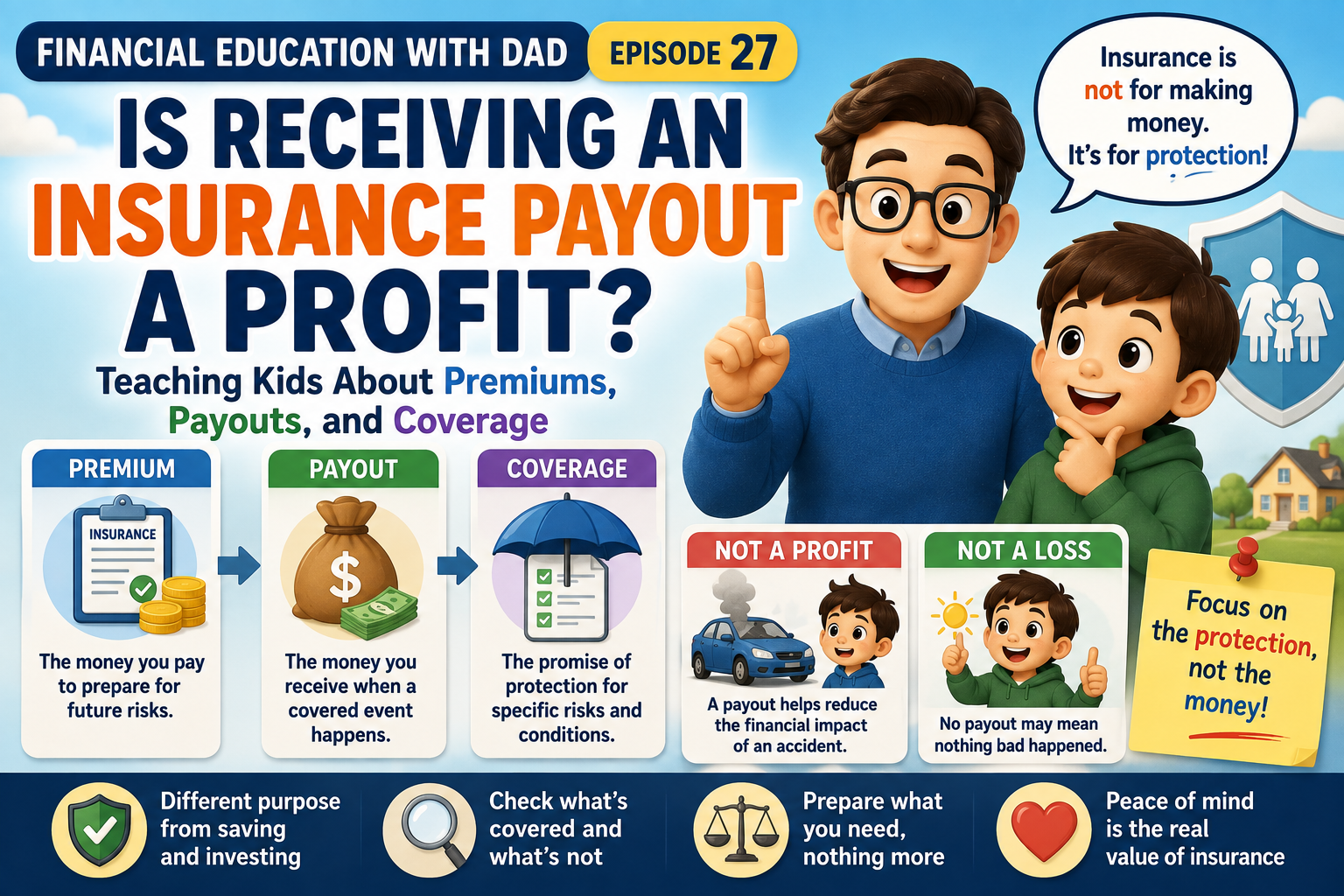
Introduction: Did We Lose Money If Nothing Happened?
Hello, I'm the writer behind The Financial Education Dad.
In Part 25, we learned why insurance exists — not primarily to make money, but as a way to prepare for unexpected financial risks too large for one person or family to handle alone. In Part 26, we went a step further into one of insurance's core principles: risk sharing — many people preparing together so the financial burden of a covered event gets reduced for whoever experiences it.
That naturally leads to an interesting question, for children and adults alike: "if I keep paying insurance premiums but never receive a payout, haven't I lost money?" And the flip side: "if I receive more from insurance than I paid in premiums, does that mean I made a profit?" Looking only at the raw numbers, it might seem that way — but reducing insurance to "money paid vs. money received" misses its real purpose. There's a crucial concept sitting between those two numbers: coverage.
In this article, let's explore what premiums and payouts really mean, what coverage actually is, why receiving no payout doesn't mean a loss, and how to help children distinguish insurance from saving and investing.
1. What Is an Insurance Premium?
A quick refresher: when you purchase insurance, you pay a certain amount according to the contract — this is the premium. Keep the explanation simple: "an insurance premium is the cost we pay to prepare for certain risks."
The key word is cost. If a child imagines premiums as money going into a personal savings jar, the whole concept gets muddled. Saving and insurance start from different purposes: saving keeps some of today's money for future use, while insurance pays a cost in exchange for protection against specific risks defined in a contract.
2. What Is an Insurance Payout?
Now the other side: an insurance payout (or benefit, or claim payment) is money paid by the insurer when a covered event occurs and the requirements for payment are met.
Explain it as: "the premium is the money we pay to prepare for risk. The insurance payout is money the insurance company may pay according to the contract when a covered event happens." A simple way to remember both:
- Insurance Premium = money paid to prepare for covered risks
- Insurance Payout = money paid according to the policy when a covered event occurs
3. What Does "Coverage" Mean?
Another essential word: coverage — the protection provided under a policy when specific events occur. For children, a simpler version works: "coverage is the promise that explains what kind of help you may receive when a certain event happens."
Having insurance doesn't guarantee a payout for every accident or problem in the world. Different policies vary in what's covered, what's excluded, how much may be paid, and how long coverage lasts. That's why the important question isn't "do we have insurance?" — it's "what does our insurance actually cover?"
4. If We Pay Premiums but Never Receive a Payout, Did We Lose Money?
Back to the central question. Imagine paying premiums for an entire year with nothing bad happening — no claim, no payout. Did that money get wasted?
Think of an umbrella. A child brings one to school because rain seems possible, but it never rains — "I carried this umbrella for nothing!" But was bringing it actually a bad call? Not necessarily — in the morning, rain was genuinely uncertain, and the umbrella was brought precisely because it might rain. Insurance works the same way: paying premiums without receiving a payout may simply mean the covered event never happened. Insurance's purpose was never waiting for something bad to happen in order to collect money — it's preparing for the financial consequences if something unexpected occurs. From that angle, no accident is very much a good outcome, not a loss.
5. If We Receive a Large Insurance Payout, Did We Make a Profit?
Now the opposite scenario. Someone pays $1,000 in premiums and later receives a $10,000 payout after a covered event. Looking at the numbers alone, a child might say, "didn't that person make $9,000?"
But it's worth asking why that payout happened. A covered accident, loss, or event occurred — inconvenience was experienced, finances may have been disrupted, daily life interrupted. The payout exists to reduce the financial burden tied to that event, not to reward the person. Explain it as: "an insurance payout isn't a prize. It is money intended to help reduce the financial burden caused by an unexpected covered event." Holding onto that sentence builds a genuinely healthier understanding of insurance.
6. Insurance and the Lottery Are Completely Different
A child might ask, reasonably: "if you pay a little money and might get a lot back later, isn't insurance like the lottery?" The purposes are fundamentally different. Lottery players pay hoping to win. People don't buy insurance hoping an accident happens — in fact, the best possible outcome is that the covered event never occurs at all.
Insurance exists to reduce the financial impact if a serious covered risk becomes reality — buying it in hopes of a big payout misunderstands its entire purpose.
7. Insurance and Saving Have Different Purposes
Draw two boxes for your child. The Savings Box holds money set aside today for a future goal or need. The Risk Protection Box represents preparation for unexpected financial risks that would be difficult to handle alone.
Both involve preparing for the future, but for different reasons — saving builds toward future goals; insurance protects against unexpected financial shocks. Once that distinction lands, children stop judging every financial tool by the same question: "how much money will I get back?"
8. Insurance and Investing Are Different Too
A preview of a topic coming later in the series. Investing generally means putting money into assets expecting their value to grow over time, while accepting the possibility of loss. Insurance's core purpose is not earning a return — it's preparing for specific risks.
Real financial products can sometimes blend elements of insurance, saving, and investing, which is exactly why adults need to understand a product's actual structure before choosing it. For children, the basics are enough:
- Saving = building money for future needs or goals
- Investing = using money with the possibility of future growth, while accepting risk
- Insurance = preparing for financial risks
9. Is More Insurance Always Better?
Not necessarily. Premiums cost money, and a family's income is limited — everyday expenses, savings, education costs, and other long-term goals all compete for the same budget. Too much going toward unnecessary premiums leaves less for everything else.
Tell your child: "preparing more is not always better. Preparing appropriately for what you really need is more important." This principle stretches well beyond insurance into most of personal finance.
10. What Kind of Coverage Does Our Family Need?
Insurance isn't something to choose just because someone else has it — every family's lifestyle, finances, and existing resources differ. Before shopping for insurance, a more useful starting question is: "what kinds of risks could cause serious financial difficulty for our family?"
From there, consider whether those risks can be prevented, handled through savings, or managed through insurance or another method. Thinking about the risk itself should always come before searching for a specific product name.
11. Teach Kids with an Umbrella, Piggy Bank, and Shield
A simple visual activity: draw three pictures. A piggy bank represents saving — money set aside for future goals. A seed or small tree represents investing — money put to work while accepting its value may change. A shield or umbrella represents insurance — preparing for the financial impact of unexpected risk.
Then present scenarios: "I want to buy a bicycle in six months" → the piggy bank. "I want to put money to work long-term, knowing its value may rise or fall" → investing. "I'm worried an unexpected major event could seriously affect our family financially" → the shield. The goal isn't picking specific products — it's understanding that different financial tools solve different problems.
12. Turn Insurance Advertisements into Financial Lessons
Next time an insurance ad appears on TV or online, use it as a teaching moment. Ask: "what kind of risk is this insurance trying to protect against? Besides how much money it says you could receive, what else should we check? Could there be situations that aren't covered?"
No need for perfect answers — the real lesson is learning not to make financial decisions based on one attractive sentence in an ad. Advertisements highlight the appealing features; actual contracts contain far more conditions worth checking first.
13. Why Insurance Policy Terms Matter
Children may eventually hear about "policy terms" — no need to study a full contract, but the basic idea matters: the policy explains what's covered, when a payout may be made, what's excluded, and other conditions.
Explain it as: "the policy terms are the written rules that explain the promises between us and the insurance company." Then attach a lifelong habit: "before agreeing to something involving money, check and understand the important terms." A principle that extends far past insurance alone.
14. What If Someone Intentionally Causes an Accident to Receive Insurance Money?
Briefly touched on in Part 26, but worth reinforcing here — intentionally causing an accident or providing false information to collect insurance money is wrong, and can carry real legal consequences. Insurance depends on trust and honest agreements; dishonest claims harm other policyholders and the system as a whole.
No complicated legal explanation needed: "honesty is one of the most important promises in insurance too." This ties directly back to the credit and trust lesson from Part 20 — in finance, trust and kept promises often come before money itself.
15. Five Things to Think About Before Buying Insurance
Children won't be choosing real insurance products yet, but these five principles matter for later:
- What risk are we trying to prepare for? Start with the purpose.
- Could we handle this risk ourselves? Some smaller risks may be manageable through savings alone.
- What does the insurance actually cover? Look past the product name into the actual coverage.
- What is not covered? Exclusions and conditions matter just as much.
- Can we continue to afford the premiums? Even useful coverage needs to fit the family's overall financial plan.
16. Three Insurance Lessons Every Child Can Remember
Across Parts 25 through 27, three sentences capture the essentials:
- Insurance is not primarily for making money. It's a way to prepare for major financial risks.
- A premium is money paid for protection against covered risks; a payout is money paid according to the policy when covered conditions are met.
- More insurance isn't always better. What matters is preparing appropriately for the risks that truly need protection.
Understanding these three ideas gives a child a genuinely solid foundation in insurance.
Conclusion: The Best Outcome Is Often No Payout at All
If premiums are paid but no payout is ever received, has money been lost? Here's how I'd put it to a child: "if nothing happened that required an insurance payout, that can be a good thing too." The goal of insurance was never receiving as much insurance money as possible — the best outcome is that nothing serious ever happens to the family at all. Because the future can't be fully predicted, though, we sometimes pay a cost in advance to prepare for certain risks anyway.
That's why insurance shouldn't be evaluated only by "how much did we pay, and how much did we get?" Better questions: "what risk were we trying to prepare for? Do we have the coverage we actually need? Can our family reasonably afford the cost?"
Teaching insurance to children was never about producing insurance-product experts. It's about helping them grow into people who can identify risks, weigh how serious they might be, and prepare for them in advance. Across Parts 25 through 27, children learned why insurance exists, how risk sharing helps people prepare together, and the promise sitting between premiums and payouts: coverage. From here, insurance stops looking like "you pay money, and if something bad happens, you get money" — and starts looking like one of several financial tools designed to protect a family's financial life from the unexpected.
Coming Next: Financial Education for Kids (Part 28)
What Is Investing? How to Explain the Difference Between Saving and Investing to Kids
So far, the series has covered saving and using insurance to prepare for unexpected risks. Now it's time for a new concept: investing. What separates putting money into a savings account from buying shares of a company? Why can investments grow in value — and why can they also lose value? And before talking about returns at all, what should children learn first?
Starting with Part 28, we begin a new arc: Investing Basics — exploring the difference between saving and investing, the relationship between risk and return, why time matters in investing, and simple everyday examples for introducing the concept to children.
— The Financial Education Dad
Previous Episode: [26] Does Sharing Risk Make It Smaller? Helping Kids Understand the Core Principle of Insurance
[26] Does Sharing Risk Make It Smaller? Helping Kids Understand the Core Principle of Insurance
Does Sharing Risk Make It Smaller? Helping Kids Understand the Core Principle of InsuranceCategory: Financial Education for Kids | Reading time: ~14 minutesIntroduction: How Can a Small Premium Cover a Large Loss?Hello, I'm the writer behind The Financial
moneyflowdad.tistory.com


